 Events
III Virtual Workshop: Educational strategies for the integration of migrant women and girls
Events
III Virtual Workshop: Educational strategies for the integration of migrant women and girls


The Latin American and Caribbean Economic System (SELA), within the framework of its Work Programme for 2026–2029, specifically under the Social Development Area and Programme III: Promoting a comprehensive vision of human mobility, is planning to hold the III Virtual Workshop: “Educational strategies for the integration of migrant women and girls,” scheduled for 15 July 2026. This activity will be conducted in partnership with the International Organisation for Migration (IOM), UN Women, the United Nations Educational, Scientific and Cultural Organisation (UNESCO) and the Economic Commission for Latin America and the Caribbean (ECLAC).
Education is a cornerstone of the social and economic integration of people on the move. In this context, the international community has paid increasing attention to the relationship between education, migration and technology as key elements in addressing the global education crisis, ensuring both access to learning and the protection of the most vulnerable populations. However, migration dynamics pose particular challenges for women and girls, who face multiple barriers that affect the continuity of their educational pathways and limit their effective access to training and development opportunities. This reality calls for coordinated and sustainable responses that help ensure the full realisation of the right to inclusive, equitable and high-quality education.
In accordance with UNESCO’s Regional Strategy on Human Mobility,[1] the successful integration of people on the move into an inclusive, equitable and high-quality education system will depend on appropriate responses from education systems, alongside the strengthening of resilient communities. In this regard, contexts of multiple crises and various migratory movements in the region have required education systems to implement appropriate and relevant responses to ensure access, retention and successful completion for people on the move, as well as for host societies, thereby strengthening the resilience of educational communities.[2] In this regard, educational institutions play an essential role as safe spaces for protection and development, especially for migrant women and girls, who find in them a means to exercise their rights and build their lives.
For its part, the IOM Strategic Plan 2024–2028[3] recognises education as a critical protective environment against the risks of exploitation faced by migrant women and girls and highlights the necessary link between migration management and shelter provision, with pathways to immediate schooling to prevent dropouts. In line with this approach, the Gender Action Plan (2022-2025) and UNICEF’s POWER4Girls[4] initiative prioritise adolescent girls’ leadership and autonomy in the classroom and promote inclusion in and through education. This report highlights the need for inclusive educational leadership and analyses the persistent barriers faced by girls in crisis contexts in completing secondary and technical education.[5]
In this context, immigration regularisation is a key enabler for the effective exercise of rights and for sustainable integration into host societies. However, it is equally essential to strengthen the education system so that they are resilient, inclusive and capable of responding to the specific needs of people on the move. The third edition of this workshop stems from the need to identify, share and promote strategies that help transform educational environments into welcoming, innovative spaces adapted to the challenges posed by contemporary human mobility. For this reason, SELA and its partner organisations will focus this edition on the vulnerabilities faced by migrant women and girls in accessing education, recognising that effective integration into education systems is a key factor in preventing risks associated with exploitation, discrimination and social exclusion.
[1] https://www.unesco.org/es/articles/estrategia-regional-de-la-unesco-sobre-movilidad-humana-para-america-latina-y-el-caribe-2022-2025?hub=66920
[2] https://www.unesco.org/gem-report/es/publication/leadership
[3] https://www.iom.int/es/plan-estrategico-de-la-oim-2024-2028
[4] https://wearepurposeful.org/wp-content/uploads/2025/03/POWER4Girls-Brochure-CSW.pdf
[5] https://www.unicef.org/media/179206/file/POWER4Girls-One-year-on-report-en.pdf.pdf
This workshop aims to strengthen the capacities of governments, academic institutions, international organisations and civil society organisations through the exchange of knowledge, the dissemination of best practices and innovative educational strategies, and the promotion of regional cooperation mechanisms that help ensure access to, retention in, and continuity of education for migrant women and girls.
It also seeks to promote comprehensive and inclusive responses that foster skills development, technical training and the effective exercise of the right to education, as key elements for their social and economic integration in countries of origin, transit, destination and return.
This event is open to key stakeholders who have a direct influence on the formulation and implementation of public policies relating to migration and education:
| Time Caracas |
Activity |
| 10:00 – 10:10 h | Opening ceremony
Gustavo Herrera, Social Development Coordinator, Latin American and Caribbean Economic System (SELA) |
| .. | |
| Moderator SELA Sayed Durán, Social Development Analyst, SELA |
|
| .. | |
| 10:10 – 10:30 h | Theme: The right to education as a cornerstone of protection
Speaker: Paula Klenner Fortess, Representative of UNESCO. UNESCO Regional Office in Santiago, Chile |
| .. | |
| 10:30– 10:50 h | Theme: Academic mobility and administrative streamlining: IOM best practices for integrating immediate access to education in host countries
Speaker: Carmen Paola Zepeda, IOM Regional Project Coordinator |
| .. | |
| 10:50 – 11:10 h | Theme: Digital transformation
Speaker: Náhury Escalona, Representative of UN Women |
| .. | |
| 11:10 – 11:30 h | Theme: Educational and labour inequalities
Speaker: Mariana Huepe Follert. Representative of ECLAC |
| .. | |
| 11:30 – 11:45 h | Question and answer session |
| .. | |
| 11:45 – 12:00h | Closing remarks |
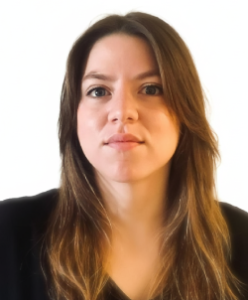 |
Paula Klenner is a clinical psychologist and holds an MSc in Sociology and Global Change from the University of Edinburgh. She has worked in civil society organisations, the public sector and the United Nations system on the design of policies and programmes for people affected by emergencies and crises, and on the coordination of regional and global strategies on education in emergencies and education for health and well-being. She has designed and coordinated national responses in contexts of extended emergencies and crises, including UNESCO’s education response in Ukraine. She has also led coordination mechanisms to address emergencies, crises and ensure school safety, such as the Global Alliance for Disaster Risk and Resilience in Education. She currently serves as Education Officer at the UNESCO Regional Office in Santiago, coordinating the Transformative Education Unit. | |
| .. | ||
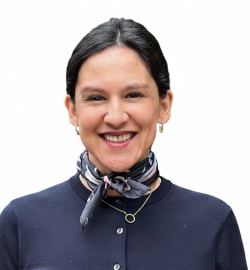 |
Mariana Huepe Follert is an economist and Social Affairs Officer in ECLAC’s Social Development Division. She holds a PhD in Development from University College London, a Master’s degree in Economics from the University of Chile, and a Master’s degree in Development from the London School of Economics. She previously worked at the United Nations Development Programme and has provided consultation for various international institutions on gender inequality and development. Her research focuses on education and labour market inclusion. | |
| .. | ||
 |
Náhury Escalona is a sociologist with a Master’s degree in Development Cooperation and Public Policy, and a specialist in social programmes and projects. She has experience in public administration, having served as Director of Economic Development and Director of Education at municipal level. She has also worked for national and international organisations in the third sector and is currently a Senior Expert at UN Women in Venezuela. She co-leads, on behalf of UN Women and in conjunction with the Resident Coordinator’s office, the Community of Companies Committed to the Women’s Empowerment Principles (WEPs). |
|
| .. | ||
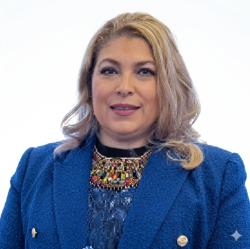 |
Carmen Paola Zepeda holds a Bachelor’s degree in Economics, specialising in Development Projects, from the American University (UAM). She has Master’s degrees in Finance (UAM–Tecnológico de Monterrey, Mexico) and in Management (INCAE), as well as postgraduate studies in Women’s Leadership with a focus on Human Rights from the Nations System Staff College. She has supplemented her education with studies in Gender (Simeon Caña University, UCA) and Leadership and Management (Keiser University). She has over 25 years’ experience in development cooperation, human rights, migration, gender and climate change, working in collaboration with international organisations. She joined the International Organisation for Migration (IOM) in 2009, holding leadership and management roles as Head of Office in Nicaragua; she has also led regional programmes in El Salvador, Honduras, Guatemala and Costa Rica. She currently serves as Chargé d’Affaires at the Chilean Mission. |
|
| .. |


 Information